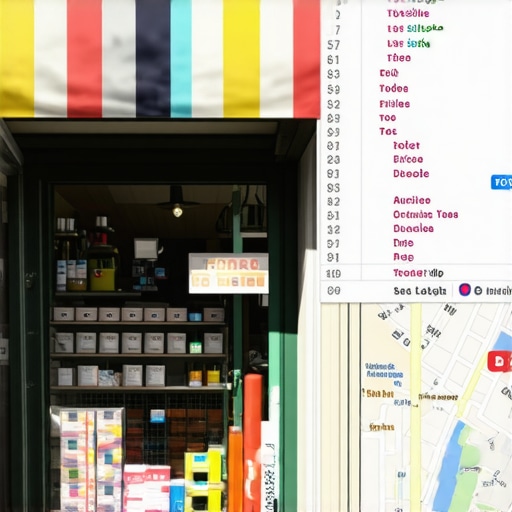
Why Your Shop’s Schema Markup is Quietly Killing Your Local Search Rank
In the high-stakes world of local digital marketing, visibility is the only currency that matters. If you are a business owner in 2026, you already know the power of the “Map Pack” – that coveted trio of local results that appears at the top of a Google search. What you might not know is that the Google Map Pack captures a staggering 44% of all local search clicks. If you aren’t in those top three spots, you are effectively invisible to nearly half of your potential customers. Yet, many businesses with hundreds of five-star reviews and optimized google business profile seo strategies find themselves stuck on page two, wondering why they can’t break through the glass ceiling. The answer isn’t usually your reviews or your photos; it’s your website’s “digital plumbing” – specifically, your schema markup.
As the founder of The Structured Data Company, I have spent years auditing the technical foundations of local businesses. Since establishing my consultancy in Kent, UK, back in 2024, I have seen a recurring theme: shops are losing the Map Pack war because their website’s schema markup is broken, outdated, or far too generic. We are no longer in an era where schema is a “nice-to-have” technical add-on. In today’s landscape, schema is the primary language that search engines and advanced AI models use to verify your physical existence, your service area, and your authority. If your code is whispering when it should be shouting, you are quietly killing your rank.
What is Schema and Why Does Google Maps Care?
To understand why your ranking is suffering, we first have to demystify what schema markup actually is. In simplest terms, schema (specifically LocalBusiness schema) is a code-based “digital business card” that lives on your website. While your human visitors see beautiful images and persuasive copy, search engines see a structured set of data points. This code tells Google exactly who you are, what you do, and – most importantly – where you are located.
Google’s local ranking algorithm is built on three pillars: Relevance, Prominence, and Distance. Schema markup influences all three. When you provide structured data, you are increasing your Relevance by explicitly defining your services. You are boosting your Prominence by linking your website to other authoritative entities like your social profiles and official registries. And you are clarifying Distance by providing precise geo-coordinates that Google can’t misinterpret.
Without this structured data, Google has to “guess” based on the unstructured text on your page. In a competitive market, Google doesn’t like to guess. It prefers the certainty of a business that provides a clear, machine-readable roadmap. Many local entrepreneurs overlook this, but fixing these technical gaps is often the catalyst for a massive jump in visibility. In fact, many of The Schema Errors Stopping North Carolina Shops From Hitting the Top 3 are rooted in this fundamental misunderstanding of how Google Maps consumes website data.
3 Fatal Schema Errors Killing Your Shop’s Visibility
If you suspect your technical SEO is holding you back, you are likely falling victim to one of these three fatal errors. These aren’t just minor bugs; they are “trust red flags” that tell Google your business might not be as reliable as it claims.
Error 1: The NAP Mismatch
NAP stands for Name, Address, and Phone Number. For Google to trust your business, this information must be identical across your website, your Google Business Profile (GBP), and your schema markup. I often see businesses that have updated their phone number on their GBP but left the old one in their website’s footer or hidden in their schema code. When Google’s bots crawl your site and find a mismatch, it creates a “trust gap.” If Google isn’t 100% sure which phone number is correct, it will hedge its bets by ranking a competitor whose data is consistent. This is a foundational element of google business profile seo that many “experts” ignore in favor of keyword stuffing.
Error 2: Generic “Organization” vs. Specific “LocalBusiness” Types
Many automated SEO plugins default to the generic Organization or WebPage schema. This is a missed opportunity of epic proportions. To rank for specific, high-intent keywords, you need to use the most specific schema type available. A plumber shouldn’t just be an “Organization”; they should be a PlumbingStore. A dentist should be a Dentist. By using specific types, you are feeding Google’s “Knowledge Graph” the exact category information it needs to match you with relevant queries. If you aren’t sure how your profile looks to the algorithm, using a google business profile audit tool can help identify where your categorization is falling short.
Error 3: Missing Geo-Coordinates
This is perhaps the most common error I see in local SEO. While you might have your address written in plain text, search engines crave precision. By including latitude and longitude within your LocalBusiness schema, you are providing the exact “pin” for your location. Without these coordinates, Google has to rely on geocoding your address string, which can sometimes be imprecise – especially in dense urban areas or new developments. In hyper-local searches, where being two blocks closer can be the difference between ranking #1 or #10, missing geo-coordinates are a death sentence for your visibility.
The 2026 Shift: AI Search and “GEO”
As we move through 2026, the landscape of search is undergoing its most significant transformation since the invention of the smartphone. We are no longer just optimizing for a list of blue links; we are optimizing for AI Overviews (SGE) and platforms like SearchGPT. This new era requires a shift from traditional SEO to GEO (Generative Engine Optimization).
AI models do not “read” websites the way humans do. They ingest data to build a factual understanding of the world. Structured data is the preferred “food” for these models. When an AI agent is asked to “find the best auto shop near me that is open now,” it doesn’t just look for keywords; it queries structured datasets to find verified facts about opening hours, service offerings, and location. If your schema isn’t robust, you won’t just lose your spot in the Map Pack – you’ll be excluded from the AI-generated answers entirely. Smart business owners are already using local seo software to ensure their data is AI-ready, making their shops the “factually preferred” choice for generative engines.
Case Study: From Page 2 to the Map Pack
To illustrate the power of technical schema, let’s look at a real-world example from Austin, Texas. A local bakery was struggling to break into the top results for “best bakery Austin.” They had a beautiful website, hundreds of reviews, and a high-quality product, yet they were perpetually stuck at the bottom of page one or the top of page two. Their GBP was optimized, but their ranking remained stagnant.
Our audit revealed that while they had “schema,” it was a generic FoodEstablishment tag with no specific menu data, no sameAs links to their social profiles, and no openingHours definition. We overhauled their code, implementing specific Bakery schema, nesting their Service offerings (custom cakes, wedding consultations), and ensuring their geo-coordinates were pinpoint accurate. Within six weeks, the bakery didn’t just move up – they secured a permanent spot in the Map Pack. This transition is a testament to the 4 Trust Signals That Finally Put This Charlotte Shop in the 3-Pack, proving that technical precision is the ultimate tie-breaker in competitive markets.
If you feel like your business is being overlooked, it’s worth investigating Why Your North Carolina Business Profile Gets Ignored by Local Searchers. Often, the culprit is a lack of technical authority that schema is designed to provide.
Expert Checklist: Auditing Your Own Schema
You don’t need to be a computer scientist to check if your digital foundation is crumbling. Use this checklist to see if your schema is working for you or against you:
- The sameAs Attribute: Does your schema include
sameAslinks to your Facebook, Instagram, LinkedIn, and Yelp profiles? This helps Google verify that all these entities belong to the same business. - Defined priceRange: Is your
priceRange(e.g., “$$” or “$$$”) defined? This is a key filter for many local searchers. - Opening Hours Synchronicity: Are your
openingHoursin the code exactly the same as they appear on your Google Business Profile? Even a 15-minute discrepancy can cause issues. - Nested Service Schema: Do you have
Serviceschema nested within yourLocalBusinesstag? Don’t just say you’re a “mechanic”; list “oil change,” “brake repair,” and “transmission service” as individual structured entities.
If you find gaps in this list, your ranking is likely suffering. Monitoring your progress with a google maps ranking service is the best way to see how fixing these errors impacts your real-world visibility over time.
Conclusion: Stop Being Invisible
The technical side of google business profile seo is often the most neglected, yet it is arguably the most impactful in 2026. You can’t build a skyscraper on a swamp; you need a solid, code-based foundation to support your local marketing efforts. If your schema markup is broken, you are essentially asking Google to find you in the dark. By cleaning up your “digital plumbing,” you remove the friction that keeps you off the first page.
Don’t let a few lines of missing code be the reason your competitors are getting the phone calls that should be yours. Audit your schema, embrace the shift toward GEO, and ensure your business is ready for the future of search. If you aren’t sure where to start, it may be time to consult with a professional who can ensure your technical SEO is a bridge to your customers, not a barrier.